A cracked heat shield, a leaking rocket, a moon lander that barely exists, a workforce being cut, and four astronauts just waiting. Here is every reason, with receipts.
1. the rocket is on the launchpad. again. for the second time.
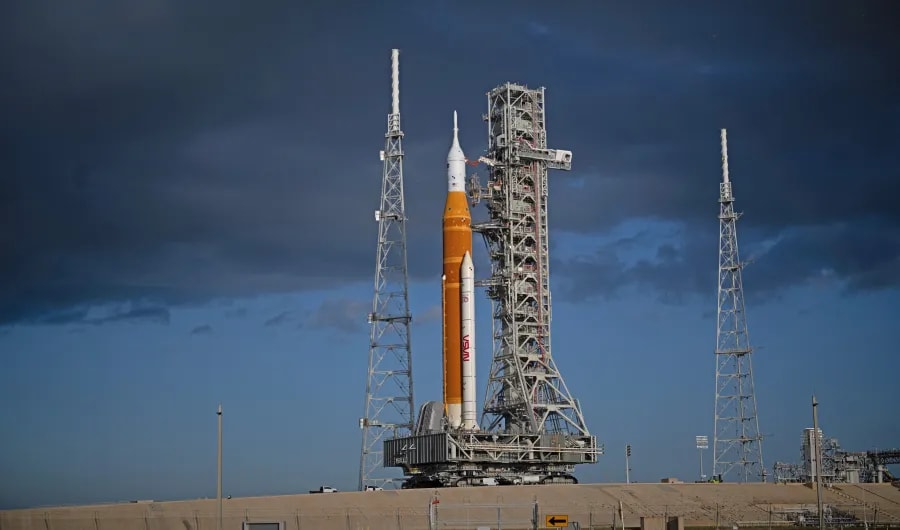
The Artemis II SLS rocket and Orion spacecraft arrive at Launch Pad 39B on March 20, 2026, after an 11-hour, 4-mile journey from the Vehicle Assembly Building. This was its second rollout. Credit: NASA
On March 20, 2026, NASA's 322-foot Space Launch System rocket finished a slow, 4-mile crawl to Launch Complex 39B at Kennedy Space Center. It moved at a maximum speed of 0.82 mph. It took 11 hours. It was the second time this rocket has made that trip.
The first rollout happened in January 2026. The rocket was rolled back on February 25 after engineers found a helium flow problem in the upper stage during a fueling rehearsal. NASA announced on March 3 the specific culprit: a faulty helium seal. Teams repaired it in the Vehicle Assembly Building, replaced batteries in the flight termination system, and ran end-to-end safety checks. Launch is now targeting no earlier than April 1, 2026. That date has already slipped once since the February rollback. The program is currently targeting launch windows across April, but there is no guarantee any of those hold either.
The Artemis II crew (left to right): Canadian Space Agency astronaut Jeremy Hansen, and NASA astronauts Reid Wiseman, Victor Glover, and Christina Koch. They entered quarantine in Houston in March 2026 ahead of the April 1 launch window. Credit: DoD / NASA
Through every rollback, every missed date, and every press conference, four astronauts have been training for a mission that keeps moving. Commander Reid Wiseman, pilot Victor Glover, mission specialist Christina Koch, and CSA astronaut Jeremy Hansen entered quarantine in Houston on March 18, 2026, for what NASA hopes is the final stretch before launch.
Glover will become the first person of color to leave Earth orbit and travel to the lunar vicinity. Koch will be the first woman. Hansen will be the first non-American. The 10-day mission will take them on a free-return trajectory around the Moon and back, reaching a distance of roughly 5,000 miles beyond the lunar surface, a record for human spaceflight. Their reentry speed of approximately 25,000 miles per hour will be the fastest ever attempted with a crew aboard a spacecraft.
When they finally lift off, they will be carrying not just their own records but the weight of a program that has been promising to deliver on its commitments for more than a decade. The rocket is on the pad. The launch window opens April 1. Whether it holds is a question nobody at NASA is ready to answer with complete confidence.
 ifiokambrose

1 Comments
four people have been waiting through all of this
The Artemis II crew (left to right): Canadian Space Agency astronaut Jeremy Hansen, and NASA astronauts Reid Wiseman, Victor Glover, and Christina Koch. They entered quarantine in Houston in March 2026 ahead of the April 1 launch window. Credit: DoD / NASA
Through every rollback, every missed date, and every press conference, four astronauts have been training for a mission that keeps moving. Commander Reid Wiseman, pilot Victor Glover, mission specialist Christina Koch, and CSA astronaut Jeremy Hansen entered quarantine in Houston on March 18, 2026, for what NASA hopes is the final stretch before launch.
Glover will become the first person of color to leave Earth orbit and travel to the lunar vicinity. Koch will be the first woman. Hansen will be the first non-American. The 10-day mission will take them on a free-return trajectory around the Moon and back, reaching a distance of roughly 5,000 miles beyond the lunar surface, a record for human spaceflight. Their reentry speed of approximately 25,000 miles per hour will be the fastest ever attempted with a crew aboard a spacecraft.
When they finally lift off, they will be carrying not just their own records but the weight of a program that has been promising to deliver on its commitments for more than a decade. The rocket is on the pad. The launch window opens April 1. Whether it holds is a question nobody at NASA is ready to answer with complete confidence.