A cracked heat shield, a leaking rocket, a moon lander that barely exists, a workforce being cut, and four astronauts just waiting. Here is every reason, with receipts.
1. the rocket is on the launchpad. again. for the second time.
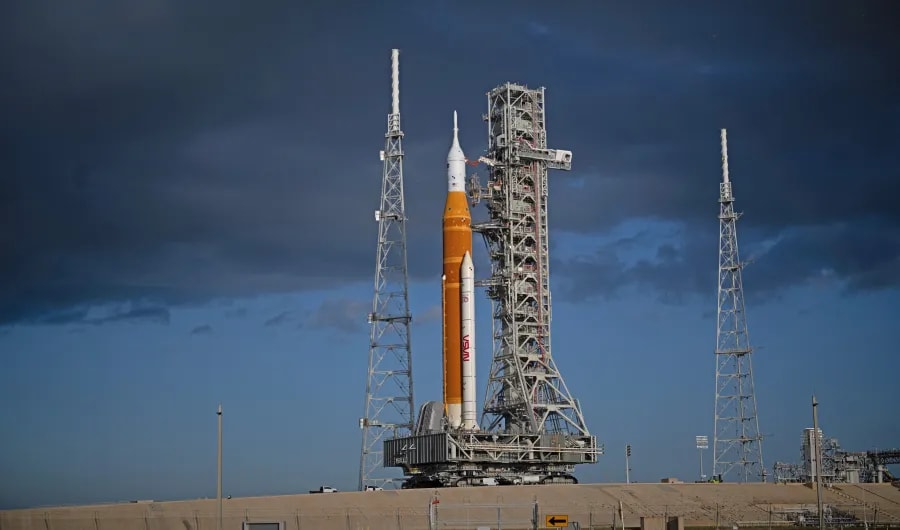
The Artemis II SLS rocket and Orion spacecraft arrive at Launch Pad 39B on March 20, 2026, after an 11-hour, 4-mile journey from the Vehicle Assembly Building. This was its second rollout. Credit: NASA
On March 20, 2026, NASA's 322-foot Space Launch System rocket finished a slow, 4-mile crawl to Launch Complex 39B at Kennedy Space Center. It moved at a maximum speed of 0.82 mph. It took 11 hours. It was the second time this rocket has made that trip.
The first rollout happened in January 2026. The rocket was rolled back on February 25 after engineers found a helium flow problem in the upper stage during a fueling rehearsal. NASA announced on March 3 the specific culprit: a faulty helium seal. Teams repaired it in the Vehicle Assembly Building, replaced batteries in the flight termination system, and ran end-to-end safety checks. Launch is now targeting no earlier than April 1, 2026. That date has already slipped once since the February rollback. The program is currently targeting launch windows across April, but there is no guarantee any of those hold either.
the heat shield broke during the test flight and NASA flew with it anyway
Post-flight inspection of the Orion crew capsule heat shield after Artemis I returned to Earth in December 2022. Engineers found char loss in over 100 locations. Credit: NASA
When the uncrewed Artemis I capsule splashed down in the Pacific Ocean in December 2022, post-flight inspection found that the heat shield's ablative material, a substance called Avcoat, had shed large chunks during reentry in more than 100 locations. The damage was worse than any preflight model had predicted.
After more than 100 tests at facilities across the country, NASA identified the root cause: gases generated inside the Avcoat material could not escape during the unique conditions of a skip reentry, where the capsule dips into the atmosphere, bounces out, then re-enters. Pressure built up underneath the surface, cracked the material, and sent pieces flying off. Ground tests had used higher heating rates that allowed gas to vent normally. The real flight was less intense, slowing char formation and trapping gas underneath.
Here is the part that raised eyebrows. By the time engineers understood the problem fully, it was too late to replace the Artemis II heat shield. The capsule had been built with the shield already installed before Artemis I even flew. NASA could not swap it out. Instead, the agency modified the reentry trajectory for Artemis II, eliminating the skip maneuver to reduce heat buildup. A redesigned, more permeable Avcoat shield will be used on Artemis III. The crew flying on Artemis II will return on the original, investigated but unfixed hardware.
"There is no flight that ever takes off where you do not have a lingering doubt."
Former NASA astronaut John Olivas, via CNN, January 2026
the rocket leaks hydrogen and has been doing so since 2022
NASA's crawler-transporter 2 carrying the Artemis II SLS rocket and Orion spacecraft rolls back to the Vehicle Assembly Building on February 25, 2026, to repair a faulty helium seal in the upper stage. Credit: NASA
Hydrogen is the smallest molecule in existence. It leaks through seals that would contain any other propellant. This is a known, fundamental problem in rocketry, and it has followed the SLS across every major test campaign since the Artemis I wet dress rehearsals in 2022.
On February 19, 2026, during the second fueling rehearsal for Artemis II, the countdown halted automatically with just five minutes remaining. Engineers had detected a helium flow anomaly in the rocket's upper stage. Cold weather at the Kennedy Space Center had also caused problems with cameras, audio equipment, and a pressurization valve for the Orion crew hatch. Rather than attempt complex repairs at the pad, NASA managers made the call to roll the entire stack back to the Vehicle Assembly Building on February 25, beginning a 12-hour, 4-mile reverse journey. The rocket was in the VAB for weeks before rolling back out on March 20.
a timeline of missed dates
Late 2024 · Original Artemis II target. Delayed by heat shield investigation and Orion battery issues.
September 2025 · New target announced in January 2024. Missed due to continued heat shield and life support system problems.
February 5, 2026 · Accelerated launch window. Helium anomaly detected during wet dress rehearsal on February 19 forces rollback.
April 1, 2026 · Current target, no earlier than. Repairs complete. Rocket at pad as of March 20.
the moon lander SpaceX was supposed to build barely exists yet
Concept art of SpaceX's Starship Human Landing System, the vehicle contracted by NASA to land astronauts on the lunar surface. The lander variant has not yet flown. Credit: SpaceX / NASA
NASA awarded SpaceX a contract in April 2021 worth $2.89 billion to develop a version of
Starship capable of carrying two astronauts from lunar orbit to the Moon's surface and back. That mission requires Starship to be refueled in Earth orbit before heading to the Moon, using a depot and roughly 12 tanker flights. Large-scale cryogenic propellant transfer between two vehicles in orbit has never been demonstrated. SpaceX was supposed to test it in March 2025. That test was delayed 12 months to March 2026. As of this article's publication, it still has not happened.
A March 2026 report by NASA's Office of Inspector General found that SpaceX's Starship lander development has slipped at least two years from its original timeline, with further delays expected. NASA's own Aerospace Safety Advisory Panel wrote in its 2026 annual report that achieving the Starship milestones needed for a crewed lunar landing mission within the next few years appeared "daunting and, to the Panel, probably not achievable."
The OIG report also flagged specific design concerns. Starship's crew cabin sits 35 meters above the lunar surface, requiring an elevator for astronauts to descend. If that elevator fails, there is currently no backup way to re-board the vehicle. NASA and SpaceX are also reported to disagree on whether Starship's landing approach meets the requirement for manual crew control, a capability used on every Apollo lunar landing.
"The development and test progress necessary for a version of Starship that has not yet flown in time to support a human lunar landing mission within the next few years appears daunting and, to the Panel, probably not achievable."
NASA Aerospace Safety Advisory Panel, 2025 Annual Report
As a direct result of these delays, NASA restructured Artemis III entirely. On February 27, 2026, NASA administrator Jared Isaacman announced that Artemis III, originally planned as the first crewed lunar landing since 1972, would instead fly to low Earth orbit in mid-2027 to conduct rendezvous and docking tests with the Starship and Blue Origin landers, analogous to the Apollo 9 mission in 1969. The actual crewed Moon landing has been pushed to Artemis IV, now targeting 2028.
NASA is also losing workers and money at the same time
While engineers were fixing the helium seal and preparing for a third rollout attempt, NASA was simultaneously dealing with a separate crisis. The agency has lost thousands of workers since late 2024 through a combination of layoffs, offered buyouts, and a culture of uncertainty created by federal workforce reductions. The UPI analysis from March 2026 listed the Artemis program's predicament alongside "turnover in top leadership positions" and "departures of thousands of NASA workers" as compounding factors in the program's overall instability.
Each SLS launch costs more than $2 billion when the rocket, Orion, and ground infrastructure are included. The mobile launcher platform that the SLS sits on during rollout cost $26 million to repair after Artemis I, five times the $5 million budgeted. The program's costs have been a persistent target for critics, and future funding under the current budget environment is not guaranteed. NASA administrator Isaacman acknowledged in the February 27 restructuring announcement that the agency needed to "rebuild core competencies" and "strengthen the workforce" to sustain the new accelerated launch cadence he was proposing.
The Artemis II crew (left to right): Canadian Space Agency astronaut Jeremy Hansen, and NASA astronauts Reid Wiseman, Victor Glover, and Christina Koch. They entered quarantine in Houston in March 2026 ahead of the April 1 launch window. Credit: DoD / NASA
Through every rollback, every missed date, and every press conference, four astronauts have been training for a mission that keeps moving. Commander Reid Wiseman, pilot Victor Glover, mission specialist Christina Koch, and CSA astronaut Jeremy Hansen entered quarantine in Houston on March 18, 2026, for what NASA hopes is the final stretch before launch.
Glover will become the first person of color to leave Earth orbit and travel to the lunar vicinity. Koch will be the first woman. Hansen will be the first non-American. The 10-day mission will take them on a free-return trajectory around the Moon and back, reaching a distance of roughly 5,000 miles beyond the lunar surface, a record for human spaceflight. Their reentry speed of approximately 25,000 miles per hour will be the fastest ever attempted with a crew aboard a spacecraft.
When they finally lift off, they will be carrying not just their own records but the weight of a program that has been promising to deliver on its commitments for more than a decade. The rocket is on the pad. The launch window opens April 1. Whether it holds is a question nobody at NASA is ready to answer with complete confidence.
 ifiokambrose

8 Comments
the heat shield broke during the test flight and NASA flew with it anyway
Post-flight inspection of the Orion crew capsule heat shield after Artemis I returned to Earth in December 2022. Engineers found char loss in over 100 locations. Credit: NASA
When the uncrewed Artemis I capsule splashed down in the Pacific Ocean in December 2022, post-flight inspection found that the heat shield's ablative material, a substance called Avcoat, had shed large chunks during reentry in more than 100 locations. The damage was worse than any preflight model had predicted.
After more than 100 tests at facilities across the country, NASA identified the root cause: gases generated inside the Avcoat material could not escape during the unique conditions of a skip reentry, where the capsule dips into the atmosphere, bounces out, then re-enters. Pressure built up underneath the surface, cracked the material, and sent pieces flying off. Ground tests had used higher heating rates that allowed gas to vent normally. The real flight was less intense, slowing char formation and trapping gas underneath.
Here is the part that raised eyebrows. By the time engineers understood the problem fully, it was too late to replace the Artemis II heat shield. The capsule had been built with the shield already installed before Artemis I even flew. NASA could not swap it out. Instead, the agency modified the reentry trajectory for Artemis II, eliminating the skip maneuver to reduce heat buildup. A redesigned, more permeable Avcoat shield will be used on Artemis III. The crew flying on Artemis II will return on the original, investigated but unfixed hardware.
the rocket leaks hydrogen and has been doing so since 2022
NASA's crawler-transporter 2 carrying the Artemis II SLS rocket and Orion spacecraft rolls back to the Vehicle Assembly Building on February 25, 2026, to repair a faulty helium seal in the upper stage. Credit: NASA
Hydrogen is the smallest molecule in existence. It leaks through seals that would contain any other propellant. This is a known, fundamental problem in rocketry, and it has followed the SLS across every major test campaign since the Artemis I wet dress rehearsals in 2022.
On February 19, 2026, during the second fueling rehearsal for Artemis II, the countdown halted automatically with just five minutes remaining. Engineers had detected a helium flow anomaly in the rocket's upper stage. Cold weather at the Kennedy Space Center had also caused problems with cameras, audio equipment, and a pressurization valve for the Orion crew hatch. Rather than attempt complex repairs at the pad, NASA managers made the call to roll the entire stack back to the Vehicle Assembly Building on February 25, beginning a 12-hour, 4-mile reverse journey. The rocket was in the VAB for weeks before rolling back out on March 20.
a timeline of missed dates
Late 2024 · Original Artemis II target. Delayed by heat shield investigation and Orion battery issues.
September 2025 · New target announced in January 2024. Missed due to continued heat shield and life support system problems.
February 5, 2026 · Accelerated launch window. Helium anomaly detected during wet dress rehearsal on February 19 forces rollback.
April 1, 2026 · Current target, no earlier than. Repairs complete. Rocket at pad as of March 20.
the moon lander SpaceX was supposed to build barely exists yet
Concept art of SpaceX's Starship Human Landing System, the vehicle contracted by NASA to land astronauts on the lunar surface. The lander variant has not yet flown. Credit: SpaceX / NASA
NASA awarded SpaceX a contract in April 2021 worth $2.89 billion to develop a version of
Starship capable of carrying two astronauts from lunar orbit to the Moon's surface and back. That mission requires Starship to be refueled in Earth orbit before heading to the Moon, using a depot and roughly 12 tanker flights. Large-scale cryogenic propellant transfer between two vehicles in orbit has never been demonstrated. SpaceX was supposed to test it in March 2025. That test was delayed 12 months to March 2026. As of this article's publication, it still has not happened.
A March 2026 report by NASA's Office of Inspector General found that SpaceX's Starship lander development has slipped at least two years from its original timeline, with further delays expected. NASA's own Aerospace Safety Advisory Panel wrote in its 2026 annual report that achieving the Starship milestones needed for a crewed lunar landing mission within the next few years appeared "daunting and, to the Panel, probably not achievable."
The OIG report also flagged specific design concerns. Starship's crew cabin sits 35 meters above the lunar surface, requiring an elevator for astronauts to descend. If that elevator fails, there is currently no backup way to re-board the vehicle. NASA and SpaceX are also reported to disagree on whether Starship's landing approach meets the requirement for manual crew control, a capability used on every Apollo lunar landing.
"The development and test progress necessary for a version of Starship that has not yet flown in time to support a human lunar landing mission within the next few years appears daunting and, to the Panel, probably not achievable."
NASA Aerospace Safety Advisory Panel, 2025 Annual Report
As a direct result of these delays, NASA restructured Artemis III entirely. On February 27, 2026, NASA administrator Jared Isaacman announced that Artemis III, originally planned as the first crewed lunar landing since 1972, would instead fly to low Earth orbit in mid-2027 to conduct rendezvous and docking tests with the Starship and Blue Origin landers, analogous to the Apollo 9 mission in 1969. The actual crewed Moon landing has been pushed to Artemis IV, now targeting 2028.
NASA is also losing workers and money at the same time
While engineers were fixing the helium seal and preparing for a third rollout attempt, NASA was simultaneously dealing with a separate crisis. The agency has lost thousands of workers since late 2024 through a combination of layoffs, offered buyouts, and a culture of uncertainty created by federal workforce reductions. The UPI analysis from March 2026 listed the Artemis program's predicament alongside "turnover in top leadership positions" and "departures of thousands of NASA workers" as compounding factors in the program's overall instability.
Each SLS launch costs more than $2 billion when the rocket, Orion, and ground infrastructure are included. The mobile launcher platform that the SLS sits on during rollout cost $26 million to repair after Artemis I, five times the $5 million budgeted. The program's costs have been a persistent target for critics, and future funding under the current budget environment is not guaranteed. NASA administrator Isaacman acknowledged in the February 27 restructuring announcement that the agency needed to "rebuild core competencies" and "strengthen the workforce" to sustain the new accelerated launch cadence he was proposing.
four people have been waiting through all of this
The Artemis II crew (left to right): Canadian Space Agency astronaut Jeremy Hansen, and NASA astronauts Reid Wiseman, Victor Glover, and Christina Koch. They entered quarantine in Houston in March 2026 ahead of the April 1 launch window. Credit: DoD / NASA
Through every rollback, every missed date, and every press conference, four astronauts have been training for a mission that keeps moving. Commander Reid Wiseman, pilot Victor Glover, mission specialist Christina Koch, and CSA astronaut Jeremy Hansen entered quarantine in Houston on March 18, 2026, for what NASA hopes is the final stretch before launch.
Glover will become the first person of color to leave Earth orbit and travel to the lunar vicinity. Koch will be the first woman. Hansen will be the first non-American. The 10-day mission will take them on a free-return trajectory around the Moon and back, reaching a distance of roughly 5,000 miles beyond the lunar surface, a record for human spaceflight. Their reentry speed of approximately 25,000 miles per hour will be the fastest ever attempted with a crew aboard a spacecraft.
When they finally lift off, they will be carrying not just their own records but the weight of a program that has been promising to deliver on its commitments for more than a decade. The rocket is on the pad. The launch window opens April 1. Whether it holds is a question nobody at NASA is ready to answer with complete confidence.
Sources
Well curated. I love the fact that you added references at the end.
anytime.
#hashtagsonzyke
When I say we never went to the moon you’ll think I’m joking.
Dawg, this is the most downvoted post on Zyke so far 😂😭. #zykehalloffame