A cracked heat shield, a leaking rocket, a moon lander that barely exists, a workforce being cut, and four astronauts just waiting. Here is every reason, with receipts.
1. the rocket is on the launchpad. again. for the second time.
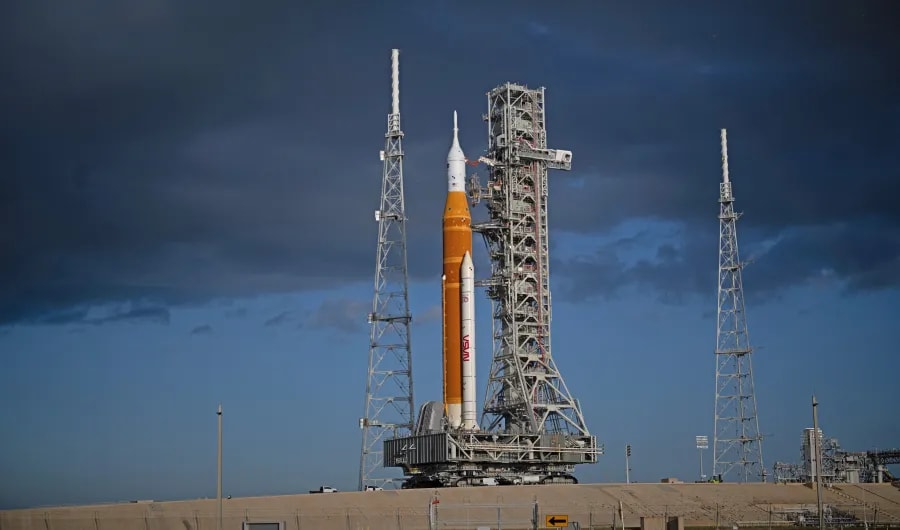
The Artemis II SLS rocket and Orion spacecraft arrive at Launch Pad 39B on March 20, 2026, after an 11-hour, 4-mile journey from the Vehicle Assembly Building. This was its second rollout. Credit: NASA
On March 20, 2026, NASA's 322-foot Space Launch System rocket finished a slow, 4-mile crawl to Launch Complex 39B at Kennedy Space Center. It moved at a maximum speed of 0.82 mph. It took 11 hours. It was the second time this rocket has made that trip.
The first rollout happened in January 2026. The rocket was rolled back on February 25 after engineers found a helium flow problem in the upper stage during a fueling rehearsal. NASA announced on March 3 the specific culprit: a faulty helium seal. Teams repaired it in the Vehicle Assembly Building, replaced batteries in the flight termination system, and ran end-to-end safety checks. Launch is now targeting no earlier than April 1, 2026. That date has already slipped once since the February rollback. The program is currently targeting launch windows across April, but there is no guarantee any of those hold either.
the moon lander SpaceX was supposed to build barely exists yet
Concept art of SpaceX's Starship Human Landing System, the vehicle contracted by NASA to land astronauts on the lunar surface. The lander variant has not yet flown. Credit: SpaceX / NASA
NASA awarded SpaceX a contract in April 2021 worth $2.89 billion to develop a version of
Starship capable of carrying two astronauts from lunar orbit to the Moon's surface and back. That mission requires Starship to be refueled in Earth orbit before heading to the Moon, using a depot and roughly 12 tanker flights. Large-scale cryogenic propellant transfer between two vehicles in orbit has never been demonstrated. SpaceX was supposed to test it in March 2025. That test was delayed 12 months to March 2026. As of this article's publication, it still has not happened.
A March 2026 report by NASA's Office of Inspector General found that SpaceX's Starship lander development has slipped at least two years from its original timeline, with further delays expected. NASA's own Aerospace Safety Advisory Panel wrote in its 2026 annual report that achieving the Starship milestones needed for a crewed lunar landing mission within the next few years appeared "daunting and, to the Panel, probably not achievable."
The OIG report also flagged specific design concerns. Starship's crew cabin sits 35 meters above the lunar surface, requiring an elevator for astronauts to descend. If that elevator fails, there is currently no backup way to re-board the vehicle. NASA and SpaceX are also reported to disagree on whether Starship's landing approach meets the requirement for manual crew control, a capability used on every Apollo lunar landing.
"The development and test progress necessary for a version of Starship that has not yet flown in time to support a human lunar landing mission within the next few years appears daunting and, to the Panel, probably not achievable."
NASA Aerospace Safety Advisory Panel, 2025 Annual Report
As a direct result of these delays, NASA restructured Artemis III entirely. On February 27, 2026, NASA administrator Jared Isaacman announced that Artemis III, originally planned as the first crewed lunar landing since 1972, would instead fly to low Earth orbit in mid-2027 to conduct rendezvous and docking tests with the Starship and Blue Origin landers, analogous to the Apollo 9 mission in 1969. The actual crewed Moon landing has been pushed to Artemis IV, now targeting 2028.
 ifiokambrose

1 Comments
the moon lander SpaceX was supposed to build barely exists yet
Concept art of SpaceX's Starship Human Landing System, the vehicle contracted by NASA to land astronauts on the lunar surface. The lander variant has not yet flown. Credit: SpaceX / NASA
NASA awarded SpaceX a contract in April 2021 worth $2.89 billion to develop a version of
Starship capable of carrying two astronauts from lunar orbit to the Moon's surface and back. That mission requires Starship to be refueled in Earth orbit before heading to the Moon, using a depot and roughly 12 tanker flights. Large-scale cryogenic propellant transfer between two vehicles in orbit has never been demonstrated. SpaceX was supposed to test it in March 2025. That test was delayed 12 months to March 2026. As of this article's publication, it still has not happened.
A March 2026 report by NASA's Office of Inspector General found that SpaceX's Starship lander development has slipped at least two years from its original timeline, with further delays expected. NASA's own Aerospace Safety Advisory Panel wrote in its 2026 annual report that achieving the Starship milestones needed for a crewed lunar landing mission within the next few years appeared "daunting and, to the Panel, probably not achievable."
The OIG report also flagged specific design concerns. Starship's crew cabin sits 35 meters above the lunar surface, requiring an elevator for astronauts to descend. If that elevator fails, there is currently no backup way to re-board the vehicle. NASA and SpaceX are also reported to disagree on whether Starship's landing approach meets the requirement for manual crew control, a capability used on every Apollo lunar landing.
"The development and test progress necessary for a version of Starship that has not yet flown in time to support a human lunar landing mission within the next few years appears daunting and, to the Panel, probably not achievable."
NASA Aerospace Safety Advisory Panel, 2025 Annual Report
As a direct result of these delays, NASA restructured Artemis III entirely. On February 27, 2026, NASA administrator Jared Isaacman announced that Artemis III, originally planned as the first crewed lunar landing since 1972, would instead fly to low Earth orbit in mid-2027 to conduct rendezvous and docking tests with the Starship and Blue Origin landers, analogous to the Apollo 9 mission in 1969. The actual crewed Moon landing has been pushed to Artemis IV, now targeting 2028.