A cracked heat shield, a leaking rocket, a moon lander that barely exists, a workforce being cut, and four astronauts just waiting. Here is every reason, with receipts.
1. the rocket is on the launchpad. again. for the second time.
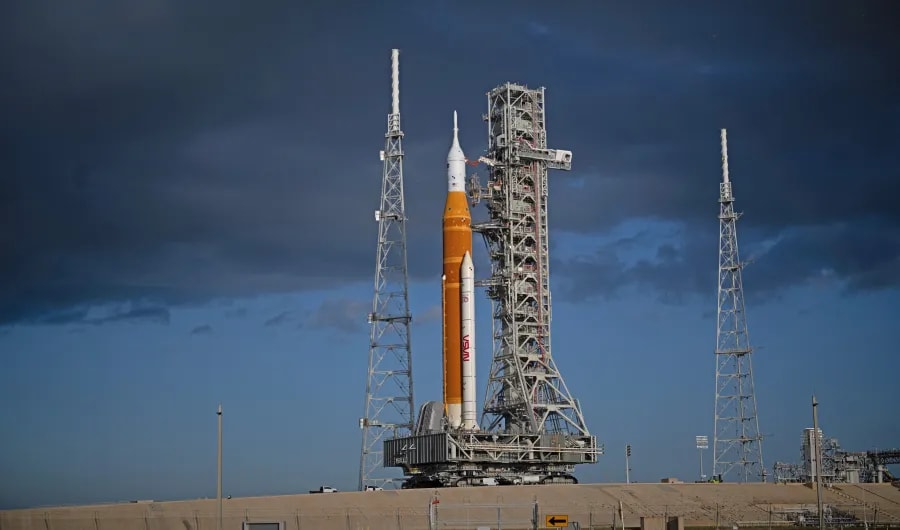
The Artemis II SLS rocket and Orion spacecraft arrive at Launch Pad 39B on March 20, 2026, after an 11-hour, 4-mile journey from the Vehicle Assembly Building. This was its second rollout. Credit: NASA
On March 20, 2026, NASA's 322-foot Space Launch System rocket finished a slow, 4-mile crawl to Launch Complex 39B at Kennedy Space Center. It moved at a maximum speed of 0.82 mph. It took 11 hours. It was the second time this rocket has made that trip.
The first rollout happened in January 2026. The rocket was rolled back on February 25 after engineers found a helium flow problem in the upper stage during a fueling rehearsal. NASA announced on March 3 the specific culprit: a faulty helium seal. Teams repaired it in the Vehicle Assembly Building, replaced batteries in the flight termination system, and ran end-to-end safety checks. Launch is now targeting no earlier than April 1, 2026. That date has already slipped once since the February rollback. The program is currently targeting launch windows across April, but there is no guarantee any of those hold either.
the heat shield broke during the test flight and NASA flew with it anyway
Post-flight inspection of the Orion crew capsule heat shield after Artemis I returned to Earth in December 2022. Engineers found char loss in over 100 locations. Credit: NASA
When the uncrewed Artemis I capsule splashed down in the Pacific Ocean in December 2022, post-flight inspection found that the heat shield's ablative material, a substance called Avcoat, had shed large chunks during reentry in more than 100 locations. The damage was worse than any preflight model had predicted.
After more than 100 tests at facilities across the country, NASA identified the root cause: gases generated inside the Avcoat material could not escape during the unique conditions of a skip reentry, where the capsule dips into the atmosphere, bounces out, then re-enters. Pressure built up underneath the surface, cracked the material, and sent pieces flying off. Ground tests had used higher heating rates that allowed gas to vent normally. The real flight was less intense, slowing char formation and trapping gas underneath.
Here is the part that raised eyebrows. By the time engineers understood the problem fully, it was too late to replace the Artemis II heat shield. The capsule had been built with the shield already installed before Artemis I even flew. NASA could not swap it out. Instead, the agency modified the reentry trajectory for Artemis II, eliminating the skip maneuver to reduce heat buildup. A redesigned, more permeable Avcoat shield will be used on Artemis III. The crew flying on Artemis II will return on the original, investigated but unfixed hardware.
"There is no flight that ever takes off where you do not have a lingering doubt."
Former NASA astronaut John Olivas, via CNN, January 2026
 ifiokambrose

1 Comments
the heat shield broke during the test flight and NASA flew with it anyway
Post-flight inspection of the Orion crew capsule heat shield after Artemis I returned to Earth in December 2022. Engineers found char loss in over 100 locations. Credit: NASA
When the uncrewed Artemis I capsule splashed down in the Pacific Ocean in December 2022, post-flight inspection found that the heat shield's ablative material, a substance called Avcoat, had shed large chunks during reentry in more than 100 locations. The damage was worse than any preflight model had predicted.
After more than 100 tests at facilities across the country, NASA identified the root cause: gases generated inside the Avcoat material could not escape during the unique conditions of a skip reentry, where the capsule dips into the atmosphere, bounces out, then re-enters. Pressure built up underneath the surface, cracked the material, and sent pieces flying off. Ground tests had used higher heating rates that allowed gas to vent normally. The real flight was less intense, slowing char formation and trapping gas underneath.
Here is the part that raised eyebrows. By the time engineers understood the problem fully, it was too late to replace the Artemis II heat shield. The capsule had been built with the shield already installed before Artemis I even flew. NASA could not swap it out. Instead, the agency modified the reentry trajectory for Artemis II, eliminating the skip maneuver to reduce heat buildup. A redesigned, more permeable Avcoat shield will be used on Artemis III. The crew flying on Artemis II will return on the original, investigated but unfixed hardware.